Views: 252 Author: Site Editor Publish Time: 2025-10-17 Origin: Site


In any environment—whether a home studio, a bustling restaurant, or a corporate boardroom—sound clarity defines the quality of the space. Noise that bounces endlessly off walls can make communication difficult and cause fatigue, while excessive echoes distort music and speech. Acoustic panels are designed to solve exactly this problem. They don’t eliminate sound; rather, they manage it, absorbing unwanted reflections and balancing frequencies to create a more comfortable and controlled acoustic environment. Understanding how acoustic panels work reveals why they are indispensable for both professional and everyday spaces.
Before exploring how acoustic panels work, it’s important to grasp the basics of how sound behaves. Sound waves travel through the air and reflect off surfaces like walls, ceilings, and floors. In an untreated room, these reflections combine with the direct sound, producing echoes, reverberation, and standing waves. The result is an uneven audio experience where some frequencies are amplified and others are canceled out.
Acoustic panels work by absorbing sound energy instead of reflecting it. They do this by converting sound waves into tiny amounts of heat through friction as the sound passes through porous materials like foam or fiberglass. This process reduces the reflections that cause echo and reverberation, allowing the original sound to be heard more clearly.
| Sound Behavior | Untreated Room | Treated with Acoustic Panels |
|---|---|---|
| Echo and Reflection | Strong reflections create harsh echoes | Reflections absorbed and diffused |
| Speech Clarity | Muffled and unclear | Clear and intelligible |
| Reverberation Time | Long and uncontrolled | Short and balanced |
| Listening Fatigue | High | Low |

At the heart of every acoustic panel is sound absorption through friction and air movement. When a sound wave hits a porous surface, it enters the material’s tiny holes or fibers. The wave’s energy causes air molecules to move within the pores, and this motion generates heat through friction. The energy transformation effectively diminishes the amplitude of the reflected wave.
Most high-quality acoustic panels use a layered structure that maximizes this effect:
| Layer | Material | Function |
|---|---|---|
| Outer Fabric | Breathable polyester or wool | Allows sound to enter while protecting inner core |
| Absorptive Core | Fiberglass, mineral wool, or acoustic foam | Converts sound energy into heat |
| Backing | Rigid frame or perforated board | Maintains structure and enhances performance |
The key principle is porosity: the more air a sound wave can move through the panel, the more energy it loses. This is why thicker panels, or those placed slightly away from walls, tend to perform better, especially at lower frequencies.
Not all acoustic panels are created equal. Their effectiveness depends heavily on material density and thickness, which determine which frequencies they can absorb.
Thin, low-density panels (25–40 mm) primarily absorb mid to high frequencies, such as speech or treble notes.
Thicker, denser panels (50–100 mm or more) can target low frequencies, often responsible for boomy or muddy sound in studios and theaters.
The Noise Reduction Coefficient (NRC) quantifies how well an acoustic panel absorbs sound. It’s expressed as a number from 0 (no absorption) to 1 (total absorption). For instance, a panel with an NRC of 0.85 absorbs 85% of the sound energy that strikes it.
| Panel Type | Thickness | NRC Value | Best For |
|---|---|---|---|
| Foam Panel | 25 mm | 0.65 | Offices, call centers |
| Fabric-Wrapped Fiberglass Panel | 50 mm | 0.85 | Studios, classrooms |
| Bass Trap (Corner Panel) | 100 mm | 0.95+ | Recording studios, home theaters |
By choosing the right density and thickness, users can tailor an acoustic panel system to their specific environment and noise control goals.
It’s common to confuse sound absorption with soundproofing, but they serve very different purposes. Acoustic panels absorb sound within a room; they do not block noise from entering or leaving. Soundproofing materials, such as mass-loaded vinyl or dense drywall, are designed to contain sound by preventing transmission through walls.
Diffusion, on the other hand, scatters sound waves evenly throughout a space without absorbing them. This helps maintain liveliness in rooms like concert halls where complete absorption would make the space sound unnaturally “dead.”
| Function | Acoustic Panels | Sound Diffusers | Soundproofing Materials |
|---|---|---|---|
| Primary Purpose | Absorb internal reflections | Scatter reflections | Block sound transmission |
| Sound Energy | Converted to heat | Redistributed | Contained or reflected |
| Common Materials | Foam, fiberglass, fabric | Wood, QRD diffusers | Vinyl, dense gypsum |
| Use Case | Studios, offices | Concert halls, theaters | Apartments, recording booths |
Understanding these differences helps designers and homeowners select the right combination of treatments for optimal sound control.
Even the most advanced acoustic panel will underperform if placed incorrectly. The key lies in strategic positioning that intercepts reflections before they cause acoustic problems.
First Reflection Points – These are areas on walls or ceilings where sound first bounces from the source to the listener. Treating these spots greatly improves clarity.
Rear Wall Reflections – In studios and home theaters, panels on the back wall prevent late reflections that distort sound.
Ceiling Clouds – Suspended panels above workspaces or mixing desks absorb vertical reflections.
Bass Traps – Placed in room corners to manage low-frequency buildup.
Professional acoustic design often combines these elements for comprehensive coverage, ensuring balanced absorption across all frequencies.
A general rule: covering 20–30% of total wall area with acoustic panels provides noticeable improvements without over-dampening the room.
While standard wall-mounted panels handle midrange frequencies, specific panel types are engineered to tackle unique acoustic challenges.
These are thicker, high-density panels designed for low-frequency absorption. They’re usually placed in corners, where bass waves tend to build up. Bass traps can dramatically improve low-end clarity in studios.
Suspended horizontally from the ceiling, these panels control reflections in large open spaces like restaurants and offices. They help reduce overall reverberation time without cluttering walls.
Combining absorption and diffusion, these panels manage reflections while preserving natural sound energy. They are ideal for spaces where liveliness and clarity must coexist, such as auditoriums.
These are versatile and visually appealing options used in offices, conference rooms, and home theaters. They combine aesthetic flexibility with high acoustic performance.
Each type works according to the same acoustic principle—energy conversion through friction—but their form factors and materials optimize them for specific frequency ranges and architectural constraints.
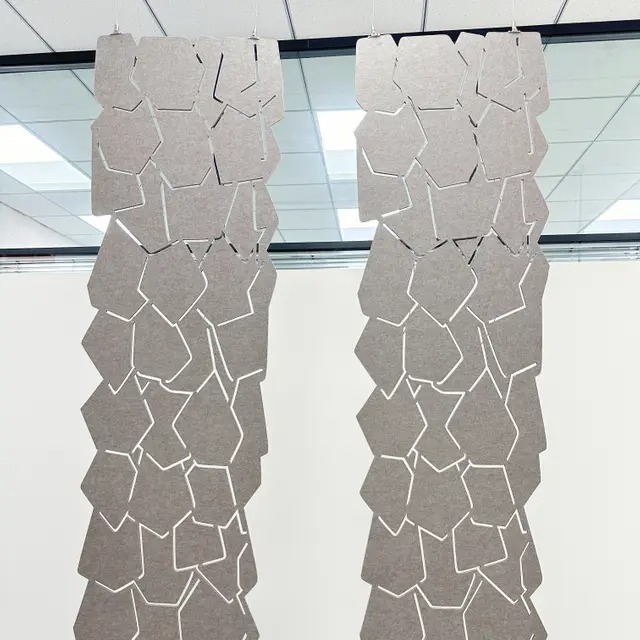
Modern acoustic panels are not only functional but also decorative. In the past, they were associated mainly with industrial or studio environments, but today’s designs integrate seamlessly into interior aesthetics.
Manufacturers offer custom fabrics, printed designs, and modular shapes, allowing architects and interior designers to treat rooms without compromising visual appeal. Some panels even double as pinboards or art pieces, combining practicality with style.
Moreover, eco-conscious materials like recycled PET felt and bamboo composites are gaining popularity, offering sustainable alternatives that perform as well as traditional fiberglass cores.
After installation, it’s crucial to evaluate how well the acoustic panels perform. Professionals use reverberation time (RT60) measurements to quantify performance. RT60 indicates how long it takes for sound to decay by 60 dB in a room.
For example:
A typical untreated office may have an RT60 of 1.2 seconds.
After adding panels, the time may drop to 0.5 seconds—an optimal range for speech clarity.
Software-based acoustic analysis tools or handheld SPL meters can help verify these results, ensuring that the chosen acoustic panel configuration achieves the desired sound profile.
The way acoustic panels work is rooted in simple but powerful physics: they transform sound energy into heat through absorption, reducing unwanted reflections and controlling reverberation. By managing how sound interacts with surfaces, they create environments that sound as good as they look.
Whether it’s a home studio seeking precision, an open-plan office aiming for speech privacy, or a restaurant desiring a more pleasant ambience, well-placed and properly chosen acoustic panels deliver measurable, transformative results. Their effectiveness lies not in blocking sound, but in shaping it—turning chaotic noise into acoustic harmony.
1. Do acoustic panels completely soundproof a room?
No. Acoustic panels absorb reflections within a room but do not block sound transmission through walls. For soundproofing, mass-loaded materials or double-wall constructions are needed.
2. How many acoustic panels do I need?
A general starting point is to cover 20–30% of the wall area. The exact number depends on room size, purpose, and the desired acoustic effect.
3. Can I install acoustic panels myself?
Yes. Most panels come with simple mounting systems such as Z-clips or adhesive strips. However, for studios or large venues, professional acoustic consultation ensures optimal placement.
4. What is the difference between foam panels and fiberglass panels?
Foam panels are lightweight and cost-effective, suitable for mid to high frequencies. Fiberglass panels offer higher density and superior absorption, especially for broader frequency ranges.
5. How long do acoustic panels last?
High-quality panels can last over 10 years if kept dry and clean. Fabric-wrapped designs are especially durable and easy to maintain.

