Views: 0 Author: Site Editor Publish Time: 2026-03-04 Origin: Site


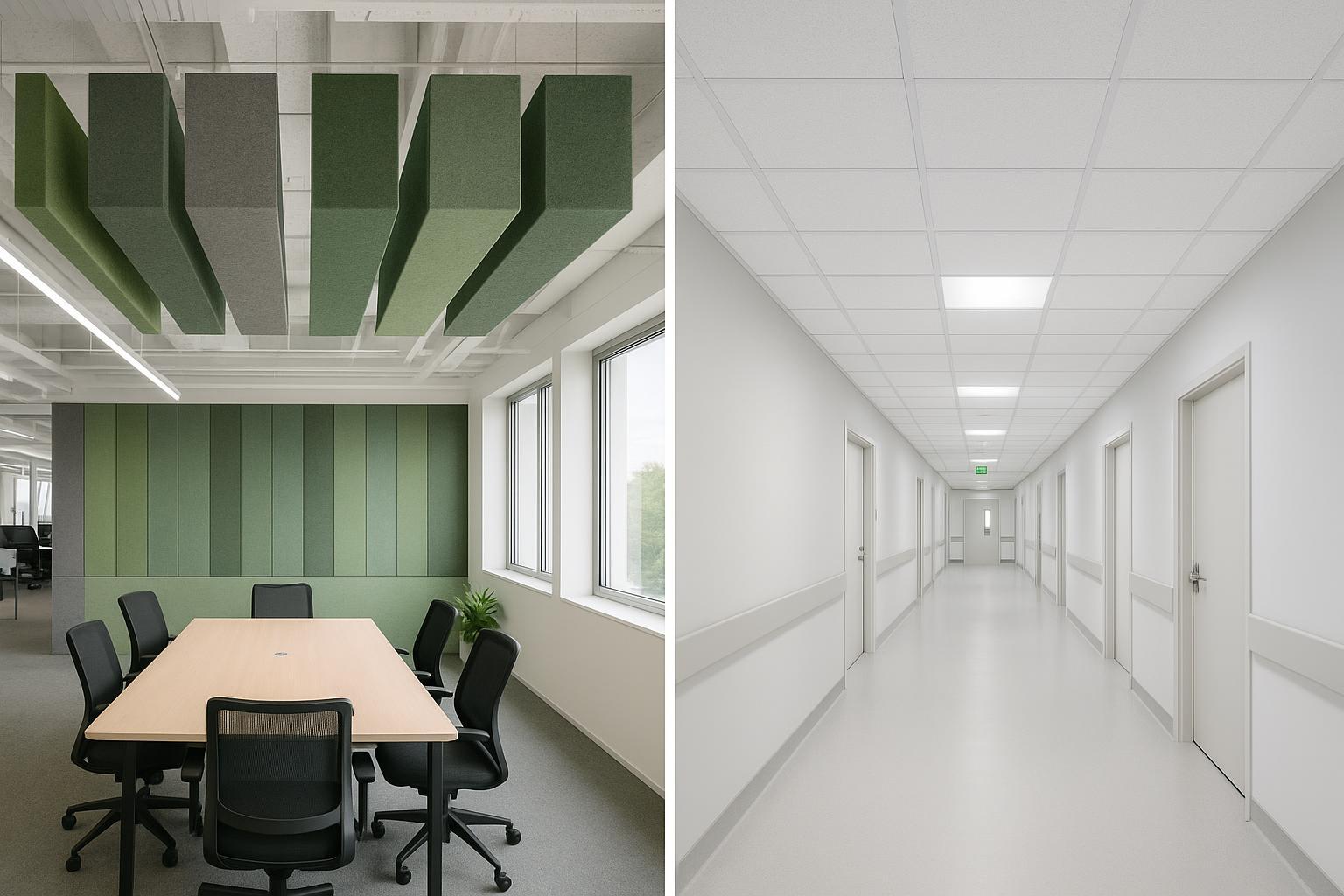
Choosing between PET acoustic felt and mineral fiber acoustic tiles isn’t just about acoustics—it’s a procurement decision that affects durability, indoor air quality (IAQ), maintenance workload, and total cost. This guide is written for procurement teams and general contractors who need clear, standards-backed direction before issuing submittal requirements or approving substitutions. In short, this comparison of PET vs mineral fiber acoustic tiles frames the trade-offs you’ll validate with current test data and supplier documentation.
Two metrics dominate early conversations. For absorption, most manufacturers report NRC per ASTM C423 in North America and αw per ISO 11654/EN ISO 354 in Europe. While these numbers often look similar, they are derived differently—so treat them as comparable indicators, not direct conversions (as explained in the Rockfon product catalogue, 2023). For privacy, Ceiling Attenuation Class (CAC) rates how well a lay-in ceiling system blocks sound through the plenum under ASTM E1414 with classification per ASTM E413. In short: NRC/αw control echoes; CAC supports speech privacy between rooms.
Beyond acoustics, procurement priorities include humidity and sag resistance, reaction-to-fire class (EN 13501-1, with ASTM E84 often cited in North America), low-emitting materials programs (e.g., CDPH Standard Method v1.2/v1.3; GREENGUARD Gold or Intertek Clean Air Gold), and ease of cleaning/disinfection.
Scope: We address ceilings and walls in commercial and residential projects and map EN-first standards to ASTM for North American readers.
Polyester (PET) felt panels are thermally bonded fibers—often with recycled rPET content—formed into sheets typically 9–12 mm thick. Common formats include wall panels, direct-attach ceiling panels, clouds, and baffles. PET is frequently chosen for its broad color options, CNC-forming flexibility, and low handling damage risk. Performance depends strongly on thickness, air gaps, and whether sound can hit both sides (as with baffles/clouds).
Mineral fiber (wet-formed) and stone wool tiles are denser, factory-finished panels designed mainly for suspended grid (lay-in) ceilings. They come in multiple edges and thicknesses (often 15–25 mm) with coatings that tune absorption and cleanability. Many product families include variants targeting high NRC, high CAC, healthcare cleanability, or high humidity resistance.
Choosing between the two categories for acoustic goals is the heart of PET vs mineral fiber acoustic tiles: absorption within rooms versus privacy across rooms.
Absorption governs reverberation control and speech clarity within a room. Typical mineral fiber lines publish NRC values from roughly 0.70 to 0.95 for premium tiles, depending on thickness and surface finish. Representative examples include product families such as Armstrong Lyra (NRC commonly in the 0.75–0.95 range per product literature, updated 2026-01-21) and Rockfon lines noted in manufacturer catalogues.
PET felt performance varies with format. Direct-attach 9–12 mm PET panels can test anywhere from approximately NRC 0.30 to 0.85 depending on mounting (air gaps/backing). Baffles and clouds expose two faces, often increasing effective absorption per square meter without covering the entire ceiling. Always check the mounting specification on the test report.
For European readers, αw per ISO 11654 is the parallel metric—use it alongside NRC when both are provided and avoid assuming a one-to-one conversion (see the Rockfon catalogue discussion of αw vs NRC, 2023: values are comparable indicators, not equivalents).
Reference: αw/NRC equivalence caveats and method notes are summarized in the Rockfon catalogue (2023) — see the manufacturer’s technical overview in the product catalogue PDF.
CAC rates the plenum-attenuation capability of sealed lay-in ceiling systems. If your project needs speech privacy between adjacent rooms, target assemblies with CAC ≥35, verified in manufacturer data based on ASTM E1414/E413. Mineral fiber tiles purpose-built for privacy can reach CAC in the upper 30s and low-to-mid 40s. Representative examples include Armstrong CALLA High CAC (datasheet indicates CAC 40) and Armstrong LYRA PB High CAC (datasheet indicates CAC in the low 40s). Stone wool lines like Rockfon Sonar publish CAC values into the mid-30s depending on configuration.
Most PET baffles/clouds aren’t rated for CAC because they’re discontinuous and don’t seal the plenum. If partition-to-ceiling flanking paths exist, baffles/clouds won’t fix privacy—consider sealed grids and barrier details instead.
Baffles/clouds (common with PET) benefit from double-sided exposure and air gaps, boosting absorption per area and enabling targeted treatment in open plans.
Lay-in mineral fiber systems balance absorption and CAC; adding plenum barriers, gaskets, or specific tile backs can raise CAC but may alter absorption.
Test values depend on thickness, air space, edge detail, and mounting type (e.g., ASTM E795). Verify the exact assembly described in the test report before assuming performance.
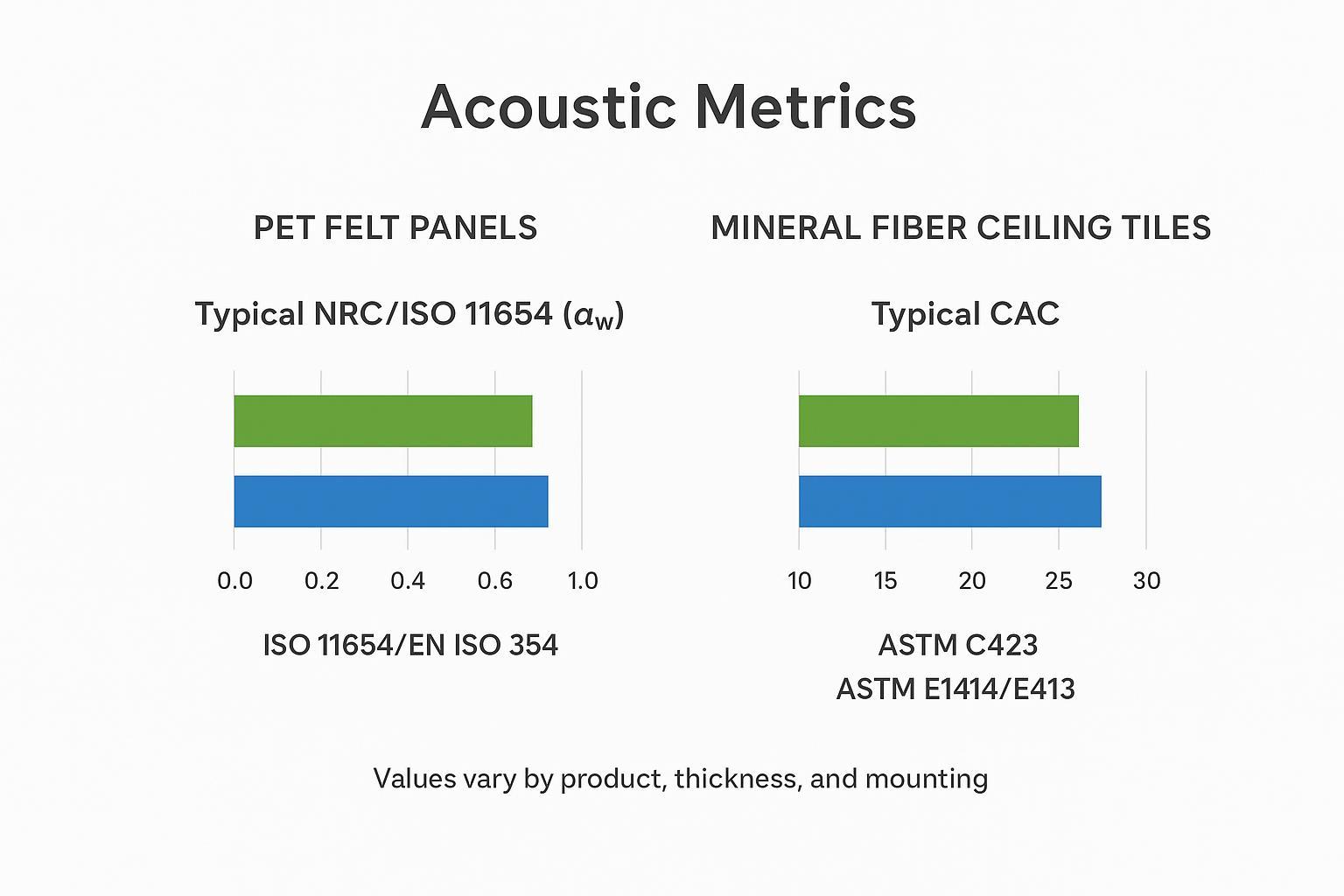
Chart shows typical NRC/αw and CAC ranges with standards: ISO 11654/EN ISO 354 and ASTM C423 for absorption; ASTM E1414/E413 for CAC. Values vary by product, thickness, and mounting.
High humidity and temperature swings can cause visual sag or dimensional change, increasing replacement risk and labor. Many healthcare- and utility-focused mineral fiber lines publish high-RH claims and sag warranties; for example, Armstrong product families reference HumiGuard Plus on select SKUs in healthcare/utility categories, with datasheets outlining conditions. Stone wool products (e.g., Rockfon Pacific) emphasize inherent moisture resistance in their technical sheets.
PET felt is often described as stable with respect to humidity and resists edge chipping during handling. However, quantified RH limits are typically system- and SKU-specific. Where PET tiles are used in grids, check the ceiling system rating; where PET baffles/clouds are used, ensure exposure conditions are within manufacturer guidance.
Examples and resources: Armstrong healthcare and utility datasheets discussing humidity resistance (e.g., Kitchen Zone, 2022-04-21) and Rockfon moisture-resistance notes in technical datasheets (e.g., Pacific, 2023-06-15).
For European specs, reference EN 13501-1 classes. Mineral fiber/stone wool tiles frequently achieve A1 or A2-s1,d0 classifications (non-combustible or limited combustibility) per manufacturer catalogues. PET felt products more commonly achieve B-s1,d0 when tested to EN 13501-1 on conforming SKUs, though results vary by thickness, facing, and adhesives. In North America, ASTM E84 surface-burning data is often provided alongside EN classifications for multinational projects. Always cite the actual classification report (lab, date, and SKU) in submittals.
Evidence anchors: Manufacturer catalogues for fire class context (e.g., Rockfon catalogue, 2023) and PET examples from published EN 13501-1 class B-s1,d0 listings on category exemplars like Woven Image EchoPanel pages.
For IAQ, verify certifications such as GREENGUARD or GREENGUARD Gold (UL 2818), Intertek Clean Air Gold, or compliance with CDPH Standard Method v1.2/v1.3. Use the official registries (e.g., UL SPOT) to confirm current listings by exact product name.
Cleaning and infection control vary widely. Many healthcare-grade mineral fiber tiles publish approvals for frequent cleaning, scrubbing, or use of disinfectants aligned with CDC/EPA guidance. PET felt generally supports vacuuming and damp wiping; some products list approved cleaners, but chemical compatibility should be confirmed per SKU to avoid discoloration or fiber distortion.
Resources: An example UL SPOT GREENGUARD Gold listing for a mineral fiber ceiling system is available in UL’s database; healthcare product pages from major manufacturers (e.g., Armstrong Health Zone) summarize approved cleaning approaches and link to detailed care guidance.
EPDs are common for mineral fiber and stone wool tiles and are published through manufacturer portals and third-party registries. They provide cradle-to-gate impacts and help with LEED/WELL documentation. PET felt suppliers often declare high recycled rPET content and may offer EPDs regionally or upon request—confirm availability during submittals.
Representative EPD resources: Armstrong and USG EPDs for specific ceiling lines, and Rockfon’s stone wool EPD documents are publicly accessible on manufacturer portals.
Some mineral fiber manufacturers operate take-back or recycling programs for ceiling tiles under defined conditions. PET felt end-of-life options depend on local recycling infrastructure and the presence of adhesives or composites. For either category, document how offcuts and replacements will be handled to reduce landfill and align with project ESG goals.
Lifecycle cost hinges on replacement frequency (sag, edge chips, staining), cleaning labor/chemicals, and downtime. Healthcare-grade mineral fiber families that tolerate aggressive disinfectants can lower risk in clinics; PET’s resiliency to edge damage can reduce handling losses during install and maintenance. Warranties vary by line; evaluate what’s covered (sag, mold/mildew, finish) and for how long.
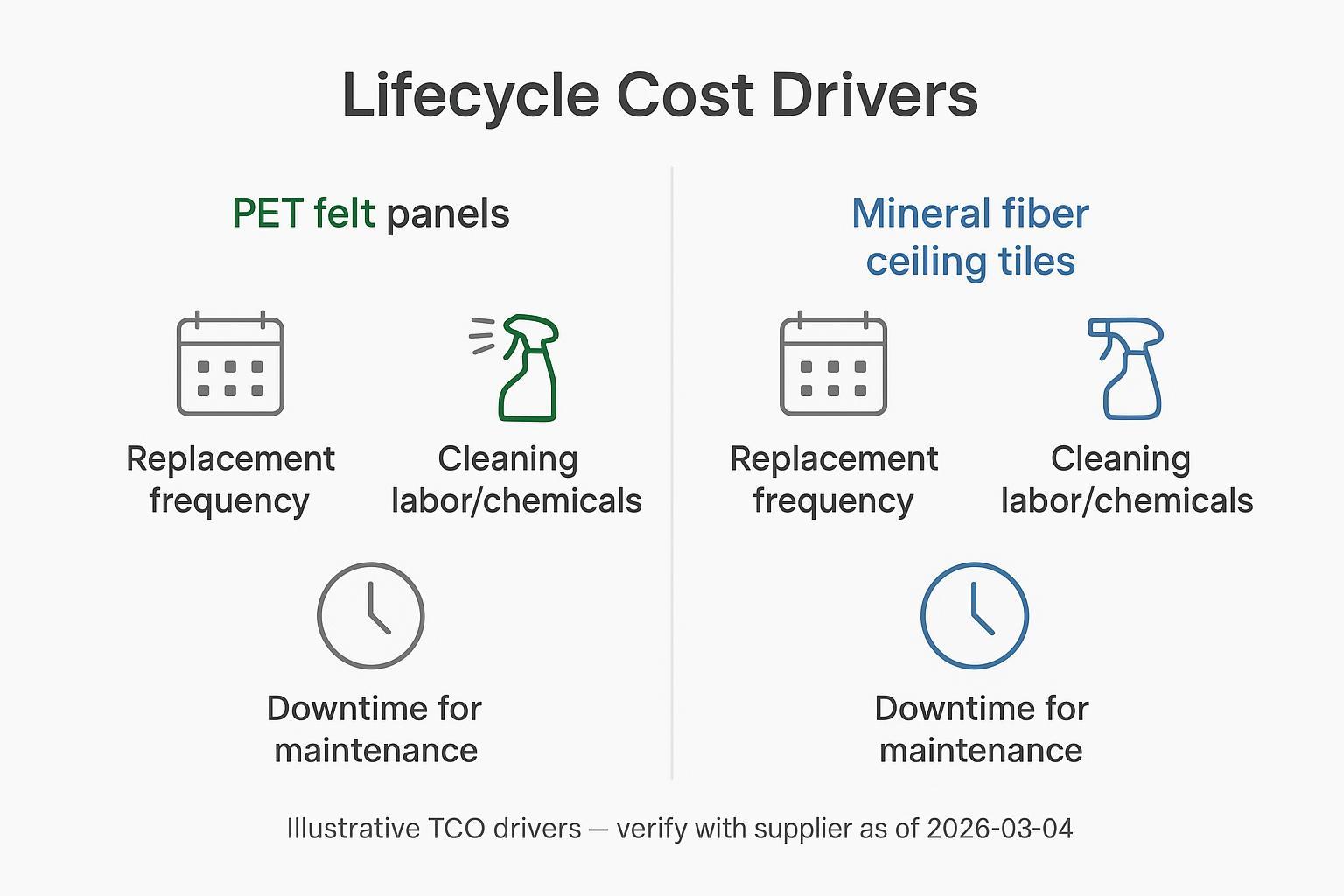
Illustrative TCO drivers — verify with suppliers as of 2026-03-04; actual costs and terms vary by region, SKU, and contract.
Open-plan offices and classrooms: PET baffles/clouds offer high effective absorption per m² thanks to double-sided exposure, allowing targeted coverage without full ceilings. Use when echo control is the primary goal and privacy between rooms is not a requirement.
Enclosed offices, exam rooms, and consult rooms: Choose mineral fiber lay-in systems with CAC ≥35 (verified to ASTM E1414/E413) to improve speech privacy through the plenum. Coordinate with partition-to-ceiling barrier details.
Healthcare and wet zones: Healthcare-grade mineral fiber tiles with high humidity/sag resistance and published cleaning/disinfection approvals reduce risk and maintenance.
Hospitality lobbies and restaurants: PET enables bold color and form factors for branding while controlling reverberation. Verify fire class and IAQ credentials per venue requirements.
Residential theaters and studios: PET wall panels and clouds can tame reflections with flexible layouts; where a conventional grid is used, mineral fiber tiles provide predictable absorption and, if needed, CAC-rated assemblies for room-to-room separation.
Start with the dominant requirement:
If you need room-side absorption in open spaces, use PET baffles/clouds or high-NRC tiles.
If you need speech privacy between rooms, require CAC ≥35 and a sealed lay-in assembly (mineral fiber lines specialize here).
If you need aggressive cleaning or high humidity resistance, prioritize healthcare-grade mineral fiber families with published protocols and RH claims.
If you need color customization or complex geometries, PET felt offers extensive palettes and CNC capability—check fire/IAQ credentials.
Also consider supplier credentials and documentation. For example, Yuheng Acoustics manufactures PET felt panels with a wide color library and customization capacity and states 58 stock colors for fast delivery. For current documentation (e.g., EN 13501-1 classification, VOC certificates, or EPDs), review their support or product pages and request test reports as needed: Yuheng Acoustics.
Both categories earn their place—your choice hinges on whether the priority is absorption in open space, privacy across rooms, or durability/IAQ under demanding conditions.
Performance: PET excels at design-forward absorption (especially baffles/clouds); mineral fiber offers predictable high NRC options and the CAC-rated assemblies needed for privacy.
Durability and IAQ: Healthcare-grade mineral fiber lines publish strong humidity and cleaning approvals; PET resists handling damage and supports low-emitting targets when certified—verify by SKU.
Cost and maintenance: PET can reduce edge-chipping replacements; mineral fiber healthcare lines can streamline cleaning. Actual TCO depends on space type, finishes, and maintenance protocols.
Selection checklist (use in specs and submittals):
Declare whether the zone requires CAC ≥35; if yes, specify sealed lay-in mineral fiber with verified ASTM E1414/E413 data.
Set absorption targets (NRC and/or ISO 11654 αw) and state mounting/air-gap requirements on drawings.
Require current fire classification (EN 13501-1 class and/or ASTM E84), VOC certificates (CDPH v1.2/v1.3; GREENGUARD/Intertek), and cleaning protocol documents.
Define humidity/sag limits, warranty terms, and acceptable disinfectants by room type.
Document end-of-life handling and any take-back participation. Time-stamp submittals and note that values are subject to change as of 2026-03-04.
References (selected):
αw vs NRC method context in the Rockfon product catalogue (2023): Rockfon product catalogue — αw and method notes
Armstrong Lyra product family page mentioning NRC ranges and HumiGuard Plus (accessed 2026-01-21): Armstrong Lyra ceiling tiles
CAC examples for mineral fiber assemblies per manufacturer datasheets: Armstrong CALLA High CAC datasheet and Armstrong LYRA PB High CAC datasheet
Stone wool CAC reference: Rockfon Sonar datasheet
Example IAQ certification registry page: UL SPOT listing for a GREENGUARD Gold ceiling system

