
Views: 0 Author: Site Editor Publish Time: 2026-10-28 Origin: Site


The integration of sound management and interior aesthetics has radically shifted how architects approach spatial design. Recent industry trend analyses reveal a surging market demand for sustainable, highly textured acoustic solutions that double as architectural focal points. Designers are no longer satisfied with functional elements merely hiding in the background. As commercial spaces increasingly prioritize acoustic wellness alongside visual impact, the reliance on standard flat boards is rapidly evolving toward integrated, three-dimensional architectural elements. The current architectural landscape demands bespoke, CNC-machined acoustics that offer both superior reverberation control and striking geometric aesthetics.
Enter the transformative technique of subtractive machining. While flat PET felt acoustic panels are exceptionally effective at dampening reverberation in their standard form, introducing precise V-grooves unlocks a completely new dimension of structural possibilities. Grooving allows engineers and designers to craft stunning 3D shapes, seamless folded corners, custom geometric patterns, and even undulating curved installations. Crucially, this is achieved without compromising the material's inherent sound-absorbing qualities. Whether you are outfitting a high-end corporate boardroom or scaling up a commercial manufacturing run, mastering the exact tools, parameters, and step-by-step techniques is mandatory for achieving flawless grooves.
Precision is Non-Negotiable: Achieving the perfect channel requires exact calibration of your cutting depth. Leaving a calculated living hinge of uncut material is strictly required for structural folding without tearing.
Tooling Dictates Quality: Industrial CNC routers equipped with specialized V-groove solid carbide bits consistently yield the cleanest cuts. Proper dust extraction is equally vital to prevent fiber melting.
Optimal Machining Parameters: Mastering the delicate balance between spindle speed and feed rate is critical. Incorrect settings generate excess friction, causing thermoplastic polyester fibers to fuse or fray uncontrollably.
Versatile Architectural Applications: Strategic routing transforms basic flat boards into complex 3D baffles, curved architectural features, and intricate slatted wall designs that elevate both aesthetics and acoustic diffusion.
Commercial Scale Efficiency: Sourcing professionally customized panels guarantees a flawless, commercial-grade finish. This approach entirely eliminates costly material waste and dramatically reduces on-site installation time.
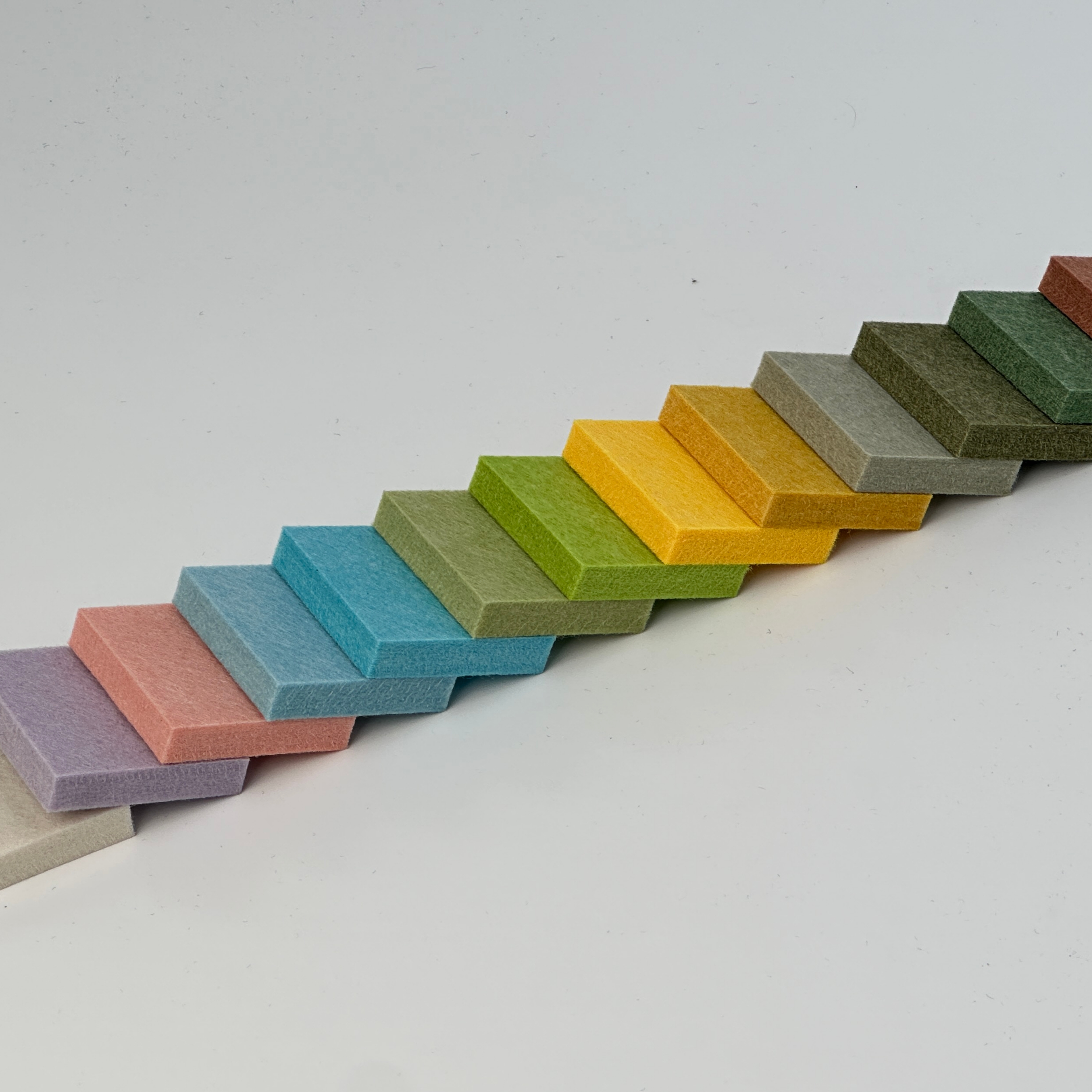
In the context of modern acoustic materials, grooving is a highly precise subtractive manufacturing process. It involves removing specific channels of material from the surface of a panel without cutting entirely through the board. Because the substrate consists of dense, compressed plastic fibers rather than solid wood or metal, this process requires specialized engineering approaches. The primary goal is to prevent the fibers from pulling or fusing under high-friction loads. The remaining thin layer of uncut material at the bottom of the trench acts as a flexible joint, enabling rigid boards to bend and fold seamlessly into three-dimensional structures.
Beyond simple aesthetics, the application of grooves serves essential architectural functions. Aesthetically, machining linear or intersecting geometric patterns creates striking visual textures. This allows synthetic felt to mimic the premium look of wood slat panels while maintaining superior acoustic absorption. Structurally, precise V-grooves form the rigid foundation for folding felt into suspended ceiling baffles or seamless corner wraps. Furthermore, grooving increases the overall exposed surface area of the panel. Consequently, this subtle physical alteration enhances the material's ability to diffuse sound waves and trap high-frequency noise, drastically improving the auditory comfort of any commercial space.
Groove Profile | Optimal Angle | Primary Architectural Application | Acoustic & Structural Benefit |
|---|---|---|---|
V-Groove | 90-Degree | Square baffles, column wraps, 90-degree corners | Creates flush seams for rigid, hollow cavities that trap low frequencies. |
Acute V-Groove | 45-Degree / 60-Degree | Triangular ceiling clouds, complex geometric 3D shapes | Allows for sharper folds and intricate, multi-faceted acoustic diffusers. |
U-Groove | Round Bottom | Decorative fluted walls, flat panel surface texturing | Increases surface area for mid-to-high frequency diffusion without folding. |
Kerf Cut | Straight / Narrow | Curved auditorium walls, undulating reception desks | Releases panel tension, allowing high-density boards to flex around tight radii. |
On the factory floor, Computer Numerical Control routers are the undisputed industry standard for commercial manufacturing. When processing porous and lightweight materials like compressed polyester, a high-capacity vacuum table is a non-negotiable feature. The powerful vacuum suction pulls the panel completely flat against the spoilboard. This ensures the cutting depth remains absolute and mathematically perfect across the entire surface. Without this stabilization, the material will lift slightly during the pass, resulting in uneven hinges or catastrophic cut-throughs.
The thermoplastic nature of polyester fibers heavily dictates your tooling choices. Standard woodworking bits will almost certainly generate too much friction. Instead, specialized solid carbide router bits are highly recommended by tooling engineers. Single-flute or double-flute designs are optimal because they provide ample space for fiber dust clearance. This prevents the material from packing into the bit and overheating. Precision is everything here. The cutting edges must be razor-sharp. A dull bit will aggressively chew and compress the fibers rather than shearing them cleanly, leaving behind a fuzzy and unacceptable finish.
While industrial machinery represents the gold standard, functional results for small-scale projects can be achieved using handheld power tools. You will need a high-quality plunge router equipped with a brand-new carbide V-groove bit. Because manual routing naturally lacks the locked-in stability of a heavy gantry, a rigid straight-edge guide must be clamped securely to the workpiece. Any dip or bow in your workbench will directly translate to an inconsistent groove depth, ultimately ruining the structural integrity of the fold.
Securing the acoustic sheet is your first critical step on the workbench. Absolute immobility dictates the quality of the cut. Begin by placing the panel on a perfectly flat sacrificial spoilboard. If operating industrial machinery, engage the vacuum zones to lock the material down firmly. For manual routing, utilize wide-jaw bar clamps to secure the panel, taking care that the clamps do not obstruct the intended path. Measure your cut lines meticulously. Standard pencils rarely leave a visible mark on highly textured surfaces, so masking tape serves as an excellent guide without damaging the felt.
Setting the depth stop is undeniably the most critical technical step in this entire process. The objective is to cut deeply enough to allow effortless folding, but shallow enough to leave a robust living hinge. Specifically, when working with premium 12mm PET felt acoustic panels featuring a dense 2400 grams per square meter composition, you must calibrate the spindle to plunge exactly 10.5mm into the material. This precise calculation leaves a 1.5mm base layer. If this hinge is too thin, it will snap under tension. Conversely, if it is too thick, the material will stubbornly resist folding and cause the exterior seam to bulge awkwardly.
Once your depth is locked in, engage the spindle and enter the material smoothly. The feed rate must be carefully managed. Moving too slowly allows the rapidly spinning bit to dwell in one place. The resulting friction will instantly melt the plastic fibers into a hard, white residue. Moving too quickly forces the bit to tear the material before it can slice, resulting in jagged edges. Maintain a steady, continuous motion from one edge of the panel to the other. Never stop the tool in the middle of a cut.
Even with a flawless cut and a brand-new bit, minor microscopic fiber fuzz may linger along the top edges of the trench. This can be easily cleaned up by lightly passing a fine-grit sanding block over the edge at a 45-degree angle. For stubborn frays, a heat gun can be deployed with extreme caution. By passing the heat quickly over the groove at a distance of several inches, loose fibers will instantly singe and retract. Linger for even a second too long, however, and you will glaze and discolor the panel permanently.
The physical mechanics of folding rely entirely on the integrity of the living hinge. The uncut material must possess enough tensile strength to hold the two halves together while remaining flexible enough to stretch around the outer radius of the bend. An empirical engineering standard across the industry is to leave a remaining thickness equal to roughly 10 to 15 percent of the total panel depth. Always conduct a test cut on a scrap piece from your specific batch. Slight density variations between color runs can affect how the hinge performs under mechanical stress.
The angle of the router bit directly dictates the final geometry of the folded architectural structure. A 90-degree angle is the standard choice for creating square boxes, rectangular baffles, and perfect corner wraps. When folded, the two 45-degree interior walls meet flush. In contrast, 60-degree and 45-degree angles are utilized for creating sharper, more complex shapes like equilateral triangular baffles. For wide, sweeping geometric transitions on flat walls, a 120-degree angle allows for gentle and shallow folds.
Because polyester boasts a relatively low melting point compared to traditional building materials, your machining parameters must prioritize heat reduction above all else. A baseline starting point for a 12mm board is a spindle speed of 16,000 to 18,000 revolutions per minute, paired with an aggressive feed rate of 5 to 8 meters per minute. The goal is to ensure the bit moves through the substrate before localized heat can build up. Operators must monitor the waste extraction closely. It should pull away as a dry, fluffy dust. If you smell melting plastic or spot hard beads forming in the trench, you must decrease the spindle speed or increase the feed rate immediately.
The most frequent issue encountered when machining synthetic acoustic boards is a poor edge finish characterized by fuzzy fibers or fused plastic. This is almost exclusively a symptom of severe heat and friction. To prevent this, strictly use dedicated tooling. Never repurpose a bit that has previously cut hard woods or medium-density fiberboard. The microscopic dulling from those hard materials is more than enough to cause aggressive tearing in polyester. Ensure your dust extraction system is functioning at peak capacity, as proper airflow pulls destructive heat away from the cutting zone.
Severing the panel entirely destroys the living hinge, instantly rendering the piece useless for folding applications. This frustrating mistake typically stems from inconsistent material thickness or an uneven cutting bed. Before making your first pass, use digital calipers to measure the panel thickness in multiple locations. Ensure the spoilboard has been freshly fly-cut so that it is perfectly parallel to the gantry. If utilizing manual tools, verify that your workbench exhibits zero bowing or sagging under downward pressure.
When attempting to create slatted designs or seamless repeating patterns across multiple panels, even a single millimeter of deviation in groove spacing becomes glaringly obvious upon installation. Rely on digital mapping and precise machine programming rather than manual measurement whenever possible. If routing manually, discard the standard tape measure for individual cuts. Instead, use a specialized indexing jig or a track saw guide rail system with built-in millimeter stops to guarantee the distance between each channel remains mathematically perfect.
One of the most visually impactful applications of V-grooving is the creation of hollow, three-dimensional ceiling structures. By routing parallel channels and folding the material into box or triangular profiles, manufacturers can assemble lightweight and highly rigid baffles. These hollow structures are incredibly efficient at trapping low-frequency sound waves within their internal cavities, while the external porous surface absorbs high-frequency reverberations. Because the material is exceptionally lightweight, these large-scale architectural clouds can be suspended safely from commercial ceilings using simple aircraft cable hardware.
While standard panels are inherently rigid, strategic grooving unlocks the remarkable ability to wrap them around curved architectural elements. This is achieved through an adapted woodworking technique known as kerfing. By cutting multiple shallow, parallel grooves very close together, the board loses its rigidity along that specific axis. This targeted flexibility allows high-density PET felt acoustic panels to flex and bend smoothly around circular columns, undulating reception desks, or curved auditorium walls without snapping. The tighter the desired radius of the curve, the closer and deeper the kerf cuts must be executed.
Moving far beyond simple linear slats, advanced machining allows for the creation of bespoke, intersecting geometric patterns. Designers can program complex networks of diagonal, vertical, and horizontal lines to create modern art-style acoustic wall cladding. These intersecting grooves catch ambient lighting, creating dynamic shadow play that shifts throughout the day. This specialized application is highly sought after in luxury corporate boardrooms and premium hospitality spaces, where the acoustic treatment must also serve as a primary interior design feature.
Taking a manual approach to subtractive carving is viable for small-budget projects where absolute millimeter precision is not mission-critical. Hobbyists who are willing to invest time in testing depth settings on scrap material can achieve satisfactory results using standard plunge routers. It is a rewarding process for those who enjoy hands-on fabrication and possess the patience to dial in manual feed rates.
However, for commercial applications, large-scale installations, or projects requiring flawless aesthetic continuity, purchasing professionally manufactured panels offers a vastly superior return on investment. Factory-grade CNC grooving ensures zero wasted material, perfect acoustic consistency, and exact dimensional tolerances. Professional manufacturing completely eliminates the risks of melted fibers, severed hinges, and inconsistent patterns. This ultimately saves significant on-site labor time and guarantees a commercial-grade finish right out of the box.
Achieving perfect grooving on synthetic acoustic boards is an intricate engineering discipline that blends acoustic science with precise subtractive machining. Whether you are programming a 5-axis CNC router for a massive commercial installation or carefully guiding a hand tool for a custom piece, respecting the material's unique density, depth requirements, and temperature thresholds is vital for success. By mastering the delicate balance of tooling, speed, and precision, you can transform a basic sound-absorbing sheet into a dynamic architectural feature.
For your next architectural acoustic project, eliminate the guesswork and labor costs associated with manual fabrication. Exploring premium PET felt acoustic panels from specialized manufacturers ensures you receive highly customizable, pre-grooved solutions tailored exactly to your design specifications. Visit YHAcoustic to discover advanced acoustic materials that guarantee stunning, professional results while perfectly balancing aesthetic vision with auditory comfort.
Yes, you can use standard woodworking routers and V-groove bits, but the cutting edges must be exceptionally sharp. Because the panels are manufactured from dense polyester fibers, dull tools will generate excessive friction. This tears and melts the thermoplastic material rather than shearing it cleanly.
No, empirical engineering data suggests that in most scenarios, grooving actually enhances the overall acoustic performance. The machining process increases the total exposed surface area of the panel, which aids in sound diffusion and traps high-frequency sound waves more effectively than a standard flat surface.
For a standard 12mm panel, you must set your plunge depth to approximately 10.5mm. This specific calibration leaves a 1.5mm living hinge of uncut material at the base. You must also ensure you are using a 90-degree V-groove bit so the two interior sides meet perfectly flush when folded.
Absolutely. By employing a machining technique known as kerfing, which involves making multiple shallow and parallel grooves very close together, rigid panels lose their stiffness along one axis. This newfound flexibility allows them to wrap smoothly around circular columns or curved architectural walls without breaking.
The optimal choice is a solid carbide, single-flute or double-flute V-groove bit. Solid carbide maintains a razor-sharp edge much longer than high-speed steel, which is crucial for cutting dense plastic fibers. The single or double-flute design provides maximum clearance for dust extraction, preventing the material from overheating and melting during the cut.
After routing, you may notice microscopic fiber fuzz along the cut line. The safest finishing method is lightly sanding the edge with a fine-grit sanding block at a 45-degree angle. For faster commercial finishing, a heat gun can be used to quickly singe away loose fibers, but it requires rapid movement to prevent glazing or burning the panel surface.