
Views: 0 Author: Site Editor Publish Time: 2026-08-06 Origin: Site


Procuring the right acoustic materials requires precise evaluation. You must meet architectural aesthetic goals while solving functional sound problems. Many professionals rely on PET acoustic panels as the industry standard for sustainable sound management. However, specifying the wrong thickness remains a common pitfall. Selecting an improper depth often means failing to solve the target acoustic problem. We must acknowledge a baseline reality. Sound absorption is governed by strict physics. Thickness directly dictates which frequencies the material absorbs. Over-promising results on thin profiles inevitably leads to project failure. We designed this guide to provide a strictly technical framework. You will discover an evidence-based approach to making the right choice. We will explore how different depths handle specific sound frequencies. You will learn practical mounting strategies to maximize acoustic performance. This ensures your final specification aligns perfectly with your environmental demands.
9 mm panels are cost-effective solutions primarily for high-frequency noise (e.g., light office chatter) and decorative surface treatments.
12 mm panels serve as the commercial standard, offering a balanced Noise Reduction Coefficient (NRC) suitable for most open-plan workspaces and educational environments.
24 mm panels provide maximum acoustic control, effectively managing mid-to-low frequencies in demanding environments like conference rooms, studios, or high-ceiling industrial spaces.
Air gaps matter: Mounting methods (e.g., direct-to-wall vs. using an air cavity) drastically alter the functional acoustic performance of any panel, often making a thinner panel perform like a thicker one.
Procurement decisions must weigh NRC requirements against fire safety compliance, budget scalability, and installation logistics.
Professionals use the Noise Reduction Coefficient (NRC) to measure sound absorption. It calculates how much acoustic energy a surface absorbs rather than reflects. NRC tightly correlates to both material density and thickness. Acoustic engineering forums frequently highlight industry skepticism regarding ultra-thin materials. Thin materials simply cannot break the laws of physics. High-frequency sounds produce short wavelengths. These short waves easily become trapped inside shallow porous structures. Conversely, low-frequency sounds carry long wavelengths and high energy. They require substantial mass, significant thickness, or trapped air to dissipate effectively.
You must understand the concept of the "air gap" or cavity backing. Installers often mount modules leaving a designated space between the material and the wall. This air cavity drastically shifts the absorption curve toward lower frequencies. The trapped air acts as an extended buffer zone. Sound waves pass through the material, enter the gap, and reflect back through the fibers again. This mounting method potentially lowers the required material thickness. You can achieve excellent broadband absorption without buying the thickest available option.
Let us look at common mistakes during specification. Many designers assume a higher density automatically equals better performance. This is only partially true. If manufacturers compress fibers too tightly, the surface becomes reflective. Sound waves bounce off rather than penetrating the core. You need the right balance of porous structure and physical depth to achieve optimal results.
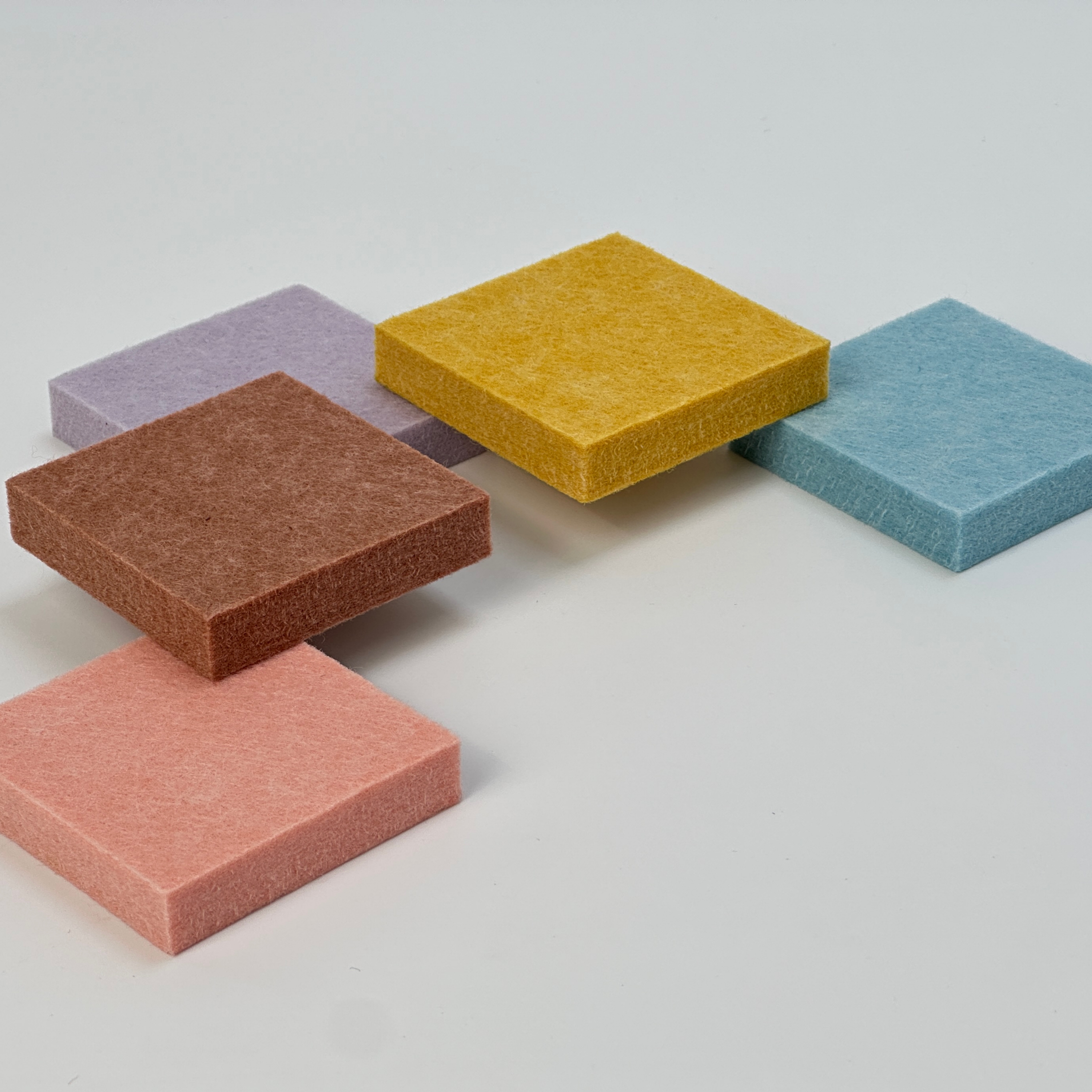
The core function of a 9 mm acoustic panel centers on high-frequency absorption and visual design. These thin profiles excel at catching short soundwaves. When mounted directly to a solid wall, they typically deliver an NRC range between 0.25 and 0.40. This rating indicates they absorb roughly 25% to 40% of the sound hitting them.
Their best use cases involve spaces where budget and aesthetics drive the project. You will find them ideal for decorative wall coverings. They work beautifully as ceiling baffles in low-noise areas. Many manufacturers use them to fabricate workstation privacy screens. They offer an exceptional option for budget-sensitive visual upgrades.
However, you must recognize their acoustic limitations. They prove highly ineffective for low-frequency rumble. They cannot absorb HVAC system drones or deep human voices. A thin profile will not solve severe reverberation issues inside large halls.
The implementation reality requires strategic planning. The material remains highly flexible and easy to cut. Installers love working with it on complex architectural curves. Yet, you must apply extensive surface coverage to make a noticeable acoustic difference. Treating just one small wall section will rarely yield meaningful results. You must cover a significant percentage of the room to alter the acoustic environment.
The 12 mm acoustic panel delivers balanced mid-to-high frequency absorption. Industry experts widely consider it the "sweet spot" for commercial builds. It bridges the gap between basic surface treatments and heavy-duty acoustic intervention.
When mounted directly to a substrate, the typical NRC ranges from 0.40 to 0.60. If you introduce a proper air cavity behind it, performance jumps significantly. Installers routinely achieve an NRC of 0.80 or higher using intelligent mounting techniques.
The best use cases span almost all standard commercial environments. They dominate open-plan offices and bustling restaurants. Educational facilities use them extensively in classrooms. They provide the perfect acoustic balance for standard meeting rooms.
The advantages of this depth extend beyond sound absorption. It offers crucial structural rigidity. You can use it for suspended ceiling baffles without worrying about sagging. It supports standalone floor partitions while maintaining a lightweight, elegant profile.
The implementation reality makes procurement highly efficient. It represents the most widely stocked thickness globally. This guarantees reliable supply chains for fast-paced construction schedules. It also ensures consistent color-matching across different production batches. Large-scale enterprise rollouts depend heavily on this predictable consistency.
Acoustic Performance Comparison Chart
Panel Thickness | Direct Mount NRC | Air Gap (50mm) NRC | Primary Frequency Target |
|---|---|---|---|
9 mm | 0.25 - 0.40 | 0.50 - 0.65 | High Frequencies (Chatter) |
12 mm | 0.40 - 0.60 | 0.70 - 0.85 | Mid-to-High Frequencies |
24 mm | 0.70 - 0.95+ | 0.85 - 1.00 | Broadband / Low Frequencies |
When a project demands aggressive acoustic intervention, a 24 mm acoustic panel becomes strictly necessary. Its core function is broadband absorption. It specifically targets problematic mid-to-low frequencies that thinner materials ignore.
This depth yields impressive direct-mount results. You can expect a typical NRC range between 0.70 and 0.95+. The dense, thick fiber matrix acts as a formidable trap for long sound wavelengths. It physically exhausts the acoustic energy as it attempts to pass through the core.
The best use cases involve acoustically demanding environments. They serve as essential components in large auditoriums and professional recording studios. Executive boardrooms utilize them to ensure absolute speech privacy. Industrial spaces dealing with heavy machinery or severe echo rely on their robust performance.
The primary advantage lies in maximum efficiency. You achieve the highest acoustic performance per square foot. Furthermore, you do not require complex wall framing to create air cavities. The material thickness itself provides the necessary depth for low-frequency management.
The implementation reality brings unique challenges. These modules are noticeably heavier and more expensive to manufacture. Installers must use robust mounting hardware to secure them properly. You will need precise cutting tools, as standard utility knives struggle to create clean edges through the thick core. Over-specifying this depth where a thinner module would suffice leads to unnecessary budget bloat. You must match the material strictly to the documented acoustic problem.
Successful PET felt panel selection requires rigorous technical vetting. Do not rely on marketing brochures. You must evaluate specific, verifiable metrics to ensure project safety and performance.
Acoustic testing transparency is non-negotiable. You should demand verifiable, third-party laboratory reports. Look for standard test methods like ASTM C423 or ISO 354. Do not accept theoretical NRC estimates based on mathematical modeling. Authentic lab reports prove exactly how the material performs across different frequency bands.
Fire safety and compliance protect both lives and property. Always verify ASTM E84 Class A or EN 13501-1 Class B ratings. Thickness occasionally impacts fire testing results. The outcome depends heavily on the manufacturer's specific density formulation. Thicker options might behave differently under direct flame than their thinner counterparts. Check the fire report for the exact thickness you intend to specify.
You must understand the relationship between density and thickness. Evaluate the weight per square meter, known as GSM (grams per square meter). A highly dense mid-weight module may actually outperform a loosely packed thick module. High GSM indicates tighter fiber entanglement. You must evaluate GSM alongside thickness to determine true material quality.
Sustainability credentials validate environmental claims. Check for accurate recycled content percentages. High-quality products use post-consumer recycled plastics. Furthermore, demand low-VOC and formaldehyde-free certifications. Respected frameworks like OEKO-TEX or GREENGUARD ensure the material will not degrade indoor air quality.
Navigating the procurement phase requires a logical, step-by-step approach. Use the following framework to finalize your material specifications.
Step 1: Define the Acoustic Target. Identify the specific acoustic flaw in your environment. Is the primary goal to reduce general flutter echo from hard surfaces? Or do you need to isolate specific low-frequency noise from mechanical systems? Defining the target frequency dictates the required depth.
Step 2: Assess the Space Constraints. Evaluate if the room's architecture allows for air-gap mounting. If you have the space to build a small wall cavity, a thinner option might easily suffice. If architectural constraints make direct-to-wall mounting mandatory, you must upgrade to the thickest option for severe echo problems.
Step 3: Budget and Scale. Calculate the total surface area required to achieve your target reverberation time. Compare the return on investment carefully. Covering 40% of a room in a mid-weight option often yields better room acoustics than covering just 20% in a premium heavy-weight option. Spreading absorption across multiple surfaces prevents flutter echoes more effectively.
You must take concrete action before authorizing a bulk order. Request physical samples directly from shortlisted manufacturers. Ask for official spec sheets and complete acoustic test reports. Verify structural integrity by handling the material. Inspect color consistency across different lighting conditions. Taking these steps prevents expensive mistakes during the final installation phase.
Choosing the appropriate depth for your acoustic treatment demands careful calculation. You must balance strict acoustic necessities, specific mounting methodologies, and overall project budgets. Thicker materials aggressively tackle low frequencies, while thinner options offer brilliant high-frequency control at a lower price point. Air gaps dramatically transform how sound interacts with any porous surface.
Remember, a universally "best" thickness does not exist. There is only the correct specification mapped to a highly documented acoustic problem. Your environment dictates the physics, and your material choice must respond accurately to those conditions.
We highly encourage consulting an acoustic engineer before signing off on large material orders. Have a professional model the exact NRC required for your specific room dimensions. Reach out to specialized manufacturers to discuss custom density requirements and mounting hardware options today.
A: An air gap significantly improves low-frequency absorption by shifting the NRC curve. Sound waves travel through the material, enter the cavity, and reflect back through the fibers. While this boosts overall performance, it does not entirely replicate the density and broadband control of a solid 24 mm extrusion. A thicker panel physically traps more sound energy within its dense core, managing low-frequency rumble more effectively.
A: Laminating panels introduces a solid adhesive layer between the two porous sheets. This glue barrier reflects sound waves prematurely, preventing them from traveling deeply into the second layer. Consequently, the laminated piece will exhibit altered, often inferior, acoustic performance compared to a monolithic 24 mm extrusion. If you require deep broadband absorption, always purchase a single, continuously extruded piece.
A: Installers prefer 12 mm and 24 mm modules for suspended ceiling baffles. These thicker profiles provide essential structural rigidity. A thin sheet lacks the internal stiffness required to hang vertically without bending. The added mass of thicker profiles prevents unsightly bowing and warping over time, ensuring the ceiling installation maintains its crisp, architectural lines for years.
A: Thinner profiles offer effortless installation. You can easily cut 9 mm and 12 mm sheets on-site using standard utility knives and straight edges. Conversely, 24 mm profiles possess dense, tough cores. Cutting them cleanly requires specialized CNC routers or heavy-duty track saws. Attempting to cut premium thick panels with standard hand tools usually results in jagged, unprofessional edges.