
Views: 0 Author: Site Editor Publish Time: 2026-11-05 Origin: Site


Open-concept spaces deliver striking visual aesthetics. Yet, they frequently fail in acoustic performance. The modern architectural dilemma is clear. The rise of expansive layouts dominated by hard surfaces like glass, polished concrete, and exposed hardwood has birthed beautiful but acoustically hostile environments. Excessive noise and echoing reduce productivity in bustling offices. They ruin intimate dining experiences with the clatter of silverware. They disrupt focus in home environments.
How do we engineer a solution without compromising the design? Enter the PET felt acoustic panel. This material represents the ultimate intersection of form, function, and sustainability. It is no longer just a functional necessity patched onto a wall. It has evolved into a highly customizable, eco-friendly design element that architects and interior designers actively use to define modern spaces. We will explore the physics behind the material, its eco-friendly origins, aesthetic versatility, and the exact engineering criteria you need to select the perfect acoustic felt panels for your specific site requirements.
Superior Acoustic Performance: Effectively absorbs mid-to-high frequency noises. It significantly improves speech intelligibility and reduces reverberation time in modern architectural spaces.
Unmatched Sustainability: Manufactured primarily from recycled plastic water bottles. These panels champion the circular economy and assist commercial buildings in earning valuable LEED certification points.
Endless Design Possibilities: Moving far beyond basic squares, modern manufacturing allows these panels to be thermoformed, V-grooved, and shaped into stunning architectural features like baffles and 3D wall art.
Safe and Practical: Unlike traditional fiberglass, PET acoustic felt is non-toxic, free of Volatile Organic Compounds, lightweight, and exceptionally easy to install and maintain.
To truly grasp the value of this material, we must first define its core component. PET stands for Polyethylene Terephthalate. Essentially, it is a highly durable, lightweight form of polyester commonly used to manufacture clear plastic water bottles and food containers. A PET Felt Acoustic Panel is a dense, non-woven fabric board created by repurposing this exact plastic waste. Through specialized acoustic engineering, recycled plastic fibers are entangled and compressed. This forms a rigid yet porous architectural material designed specifically to manage interior sound waves.
The journey from discarded consumer waste to a premium acoustic felt panel is a highly controlled, multi-step industrial process. First, post-consumer plastic bottles are collected, thoroughly washed, and shredded into tiny flakes. These flakes are then melted down and extruded into fine, continuous polyester threads.
Instead of weaving these threads, manufacturers employ a precise needle-punching and heat-pressing technique. The fibers are layered into a thick web and mechanically entangled by thousands of barbed needles. Finally, controlled heat and pressure are applied. This thermal bonding gives the panel its structural integrity. The result is a board firm enough to stand on its own but soft to the touch, requiring absolutely no chemical binders.
The term felt is adopted because the finished product closely mimics the visual texture and cozy, matte appearance of traditional pressed wool felt. However, PET felt offers vastly superior performance metrics for commercial and residential construction. Unlike natural wool, it provides exceptional durability, inherent moisture resistance, and significant cost-effectiveness. This makes it a highly practical choice for large-scale interior design projects.
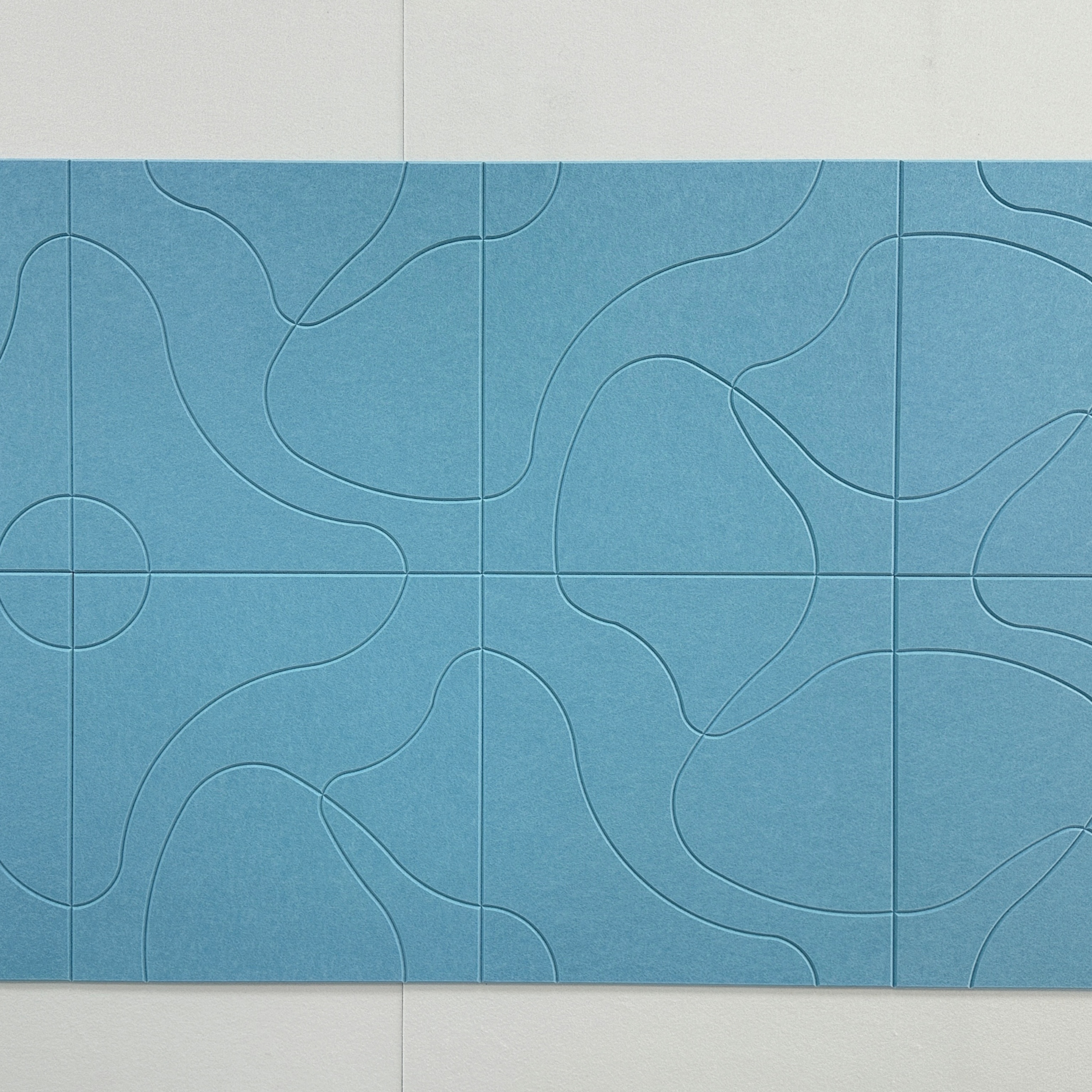
Sound absorption relies entirely on physics. When sound waves travel through a room, they reflect off hard surfaces like glass partitions and hardwood floors. This creates chaotic echoes and reverberation. A PET felt acoustic panel disrupts this process through its highly porous, interconnected fibrous structure.
As airborne sound waves enter the panel, they are forced to navigate a complex maze of entangled polyester fibers. This interaction generates viscous friction between the moving air particles and the static fibers. Consequently, the acoustic energy is converted into trace amounts of thermal energy. The noise is effectively trapped and dissipated rather than bouncing back into the room.
Acoustic performance is objectively measured using the Noise Reduction Coefficient. This metric ranges from 0.0 for completely reflective surfaces to 1.0 for completely absorptive surfaces. A typical high-quality panel carries a rating between 0.70 and 0.95. This means it absorbs 70 to 95 percent of the sound waves that strike it.
Panel thickness plays a critical role in determining which sound frequencies are most effectively absorbed. For instance, standard 9mm panels are excellent for mid-to-high frequencies like human speech and keyboard typing. Meanwhile, 24mm boards are better suited for low-frequency rumbles in auditoriums, industrial spaces, or home theaters.
For project managers and architects looking to maximize acoustic efficiency without increasing material thickness, installation methodology matters just as much. Installing acoustic felt panels with a slight air gap—such as 50mm—between the back of the panel and the rigid wall surface can significantly boost low-frequency sound absorption. The trapped air acts as an additional cushioning layer. This allows the panel to capture longer sound waves that might otherwise pass straight through a flush-mounted board.
The environmental impact of utilizing recycled PET cannot be overstated. Looking at broader industry trends, the global architectural acoustics market is undergoing a massive shift. Recent industry reports highlight a rapid transition away from high-carbon synthetic foams toward decarbonized, circular-economy materials. Driven by stringent biophilic design standards and corporate environmental goals, specifiers are demanding materials that solve noise issues without compromising indoor air quality or planetary health.
Producing a single standard-sized PET Felt Acoustic Panel can divert hundreds of plastic water bottles from ending up in landfills or polluting our oceans. By transforming single-use plastics into long-lasting architectural elements, manufacturers actively reduce the carbon footprint associated with producing virgin acoustic materials.
When evaluating building materials, indoor air quality remains a primary concern for facility managers. Traditional acoustic insulation often relies on chemical binders, formaldehyde, or fiberglass, which can compromise air safety. In stark contrast, PET felt requires no chemical adhesives during the manufacturing process. The fibers are bonded entirely through heat. As a result, these panels emit zero Volatile Organic Compounds and do not release skin-irritating micro-fibers into the HVAC system.
To make an informed purchasing decision, engineers and designers must compare PET felt against legacy sound-absorbing materials. The data below outlines exactly why PET has become the preferred specification.
Material Type | Acoustic Performance | Durability & Lifespan | Health & Safety | Cost & Installation |
|---|---|---|---|---|
PET Felt Panels | High mid-to-high frequency absorption. | 15 to 20+ years. Will not rot or crumble. | Zero VOCs. No skin irritation. Safe to handle. | Lightweight, fast installation. High ROI. |
Fiberglass Boards | Excellent broad-spectrum absorption. | Prone to sagging if fabric wrapping tears. | Requires protective gear. Fibers irritate skin/lungs. | Labor-intensive. Requires specialized handling. |
Acoustic Foam | Good high-frequency absorption. | 5 to 7 years. Degrades and turns yellow under UV. | Can off-gas chemicals. Highly flammable if untreated. | Cheap upfront, but requires frequent replacement. |
Wood Slat Panels | Good diffusion. Relies on backing for absorption. | Very durable but susceptible to moisture damage. | Safe, but heavy. Dust generation during cutting. | High material and shipping costs. Heavy mounting needed. |
Historically, acoustic treatments were viewed as a necessary nuisance. Designers desperately tried to hide bulky, unattractive foam wedges or fabric-wrapped fiberglass boards. The introduction of PET felt has completely revolutionized this paradigm. Thanks to precision CNC cutting and thermoforming, acoustic panels are now celebrated as focal points.
Modern architecture frequently embraces organic, flowing lines to soften the rigid geometry of commercial spaces. Thermoforming technology allows rigid PET felt to be permanently molded into structural waves and arcs. Integrating a Curved PET felt acoustic panel into a ceiling or wall design adds profound depth and visual interest. Furthermore, curved surfaces inherently offer enhanced sound diffusion. They scatter sound waves in multiple directions to prevent dead spots and create a highly natural acoustic environment.
Unlike materials that are merely painted on the surface, PET felt is typically dyed through the fiber during the extrusion process. This ensures absolute color consistency throughout the entire thickness of the board and provides excellent UV resistance against fading. Designers can specify custom-cut company logos, intricate geometric patterns, and precise V-groove textures directly into the acoustic felt.
The modern open-plan office is notorious for poor acoustics. This leads to decreased employee productivity and increased stress. PET felt is extensively utilized here in the form of desk dividers, suspended ceiling baffles, and modular wall panels. By strategically placing these elements, facility managers can reduce ambient chatter and create localized zones of focus without building permanent drywalls.
Aesthetic appeal is critical in restaurants and cafes, but poor acoustics can ruin a dining experience. The din created by clinking silverware, espresso machines, and overlapping conversations quickly becomes overwhelming in minimalist spaces with exposed concrete. Acoustic felt panels can be subtly integrated into the ceiling topography to absorb this reverberation.
In classrooms and lecture halls, speech intelligibility is the most critical metric. If students cannot clearly hear the instructor due to excessive echo, learning outcomes suffer. PET felt provides a durable, impact-resistant solution. It can withstand the wear and tear of high-traffic areas while ensuring acoustic clarity reaches the back row.
One of the most significant empirical benefits of PET felt is its exceptionally low mass. Depending on the density and thickness, a standard panel typically weighs between 1.3 to 2.4 kilograms per square meter. This lightweight profile eliminates the need for heavy structural reinforcement. It allows for rapid deployment across large commercial spaces.
Contractors typically utilize several primary installation methodologies. Direct adhesion using VOC-free construction glue is perfect for drywall or concrete. For high-end commercial spaces, mechanical fastening via aluminum Z-clips allows for easy removal and creates a beneficial acoustic air gap. Suspension hardware is ideal for open-plenum ceilings, maximizing sound absorption by exposing both sides of acoustic clouds and baffles.
From a facility management perspective, the polymer structure of PET is inherently hydrophobic. The fibers repel moisture, making the panels highly resistant to ambient humidity and preventing the proliferation of mold and mildew.
Routine maintenance is minimal. Facility managers simply need to use a HEPA-filtered vacuum with a soft brush attachment to remove surface dust every few months. In the event of localized staining, the material's chemical resistance allows for straightforward spot cleaning with mild detergent and warm water.
Selecting the appropriate acoustic treatment requires a systematic evaluation of the space's acoustic deficiencies. Decision-makers should rely on standardized metrics rather than subjective marketing claims.
Step 1: Determine the Frequency Target. The thickness of the PET felt directly correlates with its acoustic performance. Use 9mm panels for mitigating standard office chatter. Upgrade to 12mm panels for enhanced mid-frequency absorption in conference rooms. Specify 24mm boards for low-frequency control in home theaters or industrial spaces.
Step 2: Check Fire Safety Regulations. For commercial projects, adherence to local fire codes is non-negotiable. Verify fire-retardant properties through standardized testing. Buyers should strictly specify panels that achieve an ASTM E84 Class A rating in North America or a Class B-s1, d0 rating in Europe.
Step 3: Evaluate Architectural Form. Do not limit your design to flat boards. Consider how a curved acoustic panel can break up standing waves while elevating the visual environment. Check the manufacturer's capabilities for CNC routing and thermoforming.
The PET felt acoustic panel is undeniably a revolutionary material. It bridges the gap between high-performance sound absorption, striking visual design, and crucial environmental sustainability. Modern architecture should never treat acoustics as an afterthought hidden away in the ceiling plenum. Sound control must be an engineered, integral feature of room design.
Whether you are outfitting a bustling corporate office, an intimate cafe, or a high-end home theater, it is time to upgrade your environment. Evaluate your site conditions and explore the premium options available at YH Acoustic. From standard boards to advanced curved configurations, you can find the exact specifications needed to transform your noisy spaces into havens of focus and aesthetic brilliance.
Very few organic or synthetic building materials are entirely fireproof. However, high-quality PET felt acoustic panels are engineered to be highly fire-retardant. During manufacturing, the polyester fibers are structured to resist ignition. Ensure the panels have been independently tested to meet ASTM E84 Class A or EN 13501-1 Class B standards, confirming low flame spread and minimal smoke generation.
It is strongly advised against painting any acoustic felt material. The acoustic efficacy relies entirely on its porous, microscopic structure. Applying liquid paint to the surface will seal these pores, creating a hard, reflective shell and destroying the sound-absorbing properties. Fortunately, PET felt is manufactured using color-fast dyes and is available in dozens of vibrant colors.
The longevity of PET felt is a massive advantage over traditional acoustic foam. Polyurethane foam degrades, becomes brittle, and crumbles within 5 to 7 years due to UV exposure. PET is a highly stable thermoplastic polymer. It does not rot or lose its structural integrity over time. With basic maintenance, it will easily perform for 15 to 20 years or more.
This is a common misconception in acoustic design. You must distinguish between sound absorption and sound blocking. A PET felt acoustic panel is a sound absorber. It reduces echo and ambient noise within a specific room. Because it is lightweight and porous, it lacks the dense mass required to block sound transmission through walls.
Yes, PET felt is exceptionally safe for residential environments. Traditional acoustic insulation like fiberglass can shed microscopic silicate fibers that irritate the skin and lungs. PET felt is made from the exact same polyester fibers used in clothing and blankets. It is completely non-toxic and preserves pristine indoor air quality.
Maintenance is incredibly simple due to the hydrophobic nature of the polyester fibers. For regular upkeep, gently vacuum the surface using a soft brush attachment to remove airborne dust. For accidental spills or stains, lightly dab the area with a clean cloth, mild soap, and warm water. Avoid harsh industrial solvents.
Absolutely. Thickness dictates the range of sound frequencies the panel can absorb. A standard 9mm panel is highly effective for human speech and high-frequency noise. If you are dealing with low-frequency sounds like heavy bass or HVAC mechanical rumbles, you must step up to 12mm or 24mm panels, or install the panels with a significant air gap behind them.