Views: 0 Author: Site Editor Publish Time: 2026-03-04 Origin: Site


You might ask, "How much do acoustic panels cost?" In 2026, economy kits are priced from $508.48 to $664.94. Standard panels range between $47 and $265 each. The cost increases with custom colors, shapes, or branding. Additionally, tariffs and changes in materials can affect the price. Many buyers overlook installation, shipping, or return fees when budgeting for their purchase.
In 2026, economy kits for acoustic panels cost from $508.48 to $664.94. Standard panels cost between $47 and $265 each.
Customization options like colors and shapes make acoustic panels more expensive. Always ask for a full price estimate so you are not surprised.
To find out how many panels you need, measure your wall area. Then calculate how much coverage you want. Use easy rules to guess the right number.
Acoustic panels last longer than soundproof foam. They also control sound better. This makes them a good choice for long-term use.
Prices for acoustic panels change based on material, size, and design. Think about your budget and needs when picking panels.
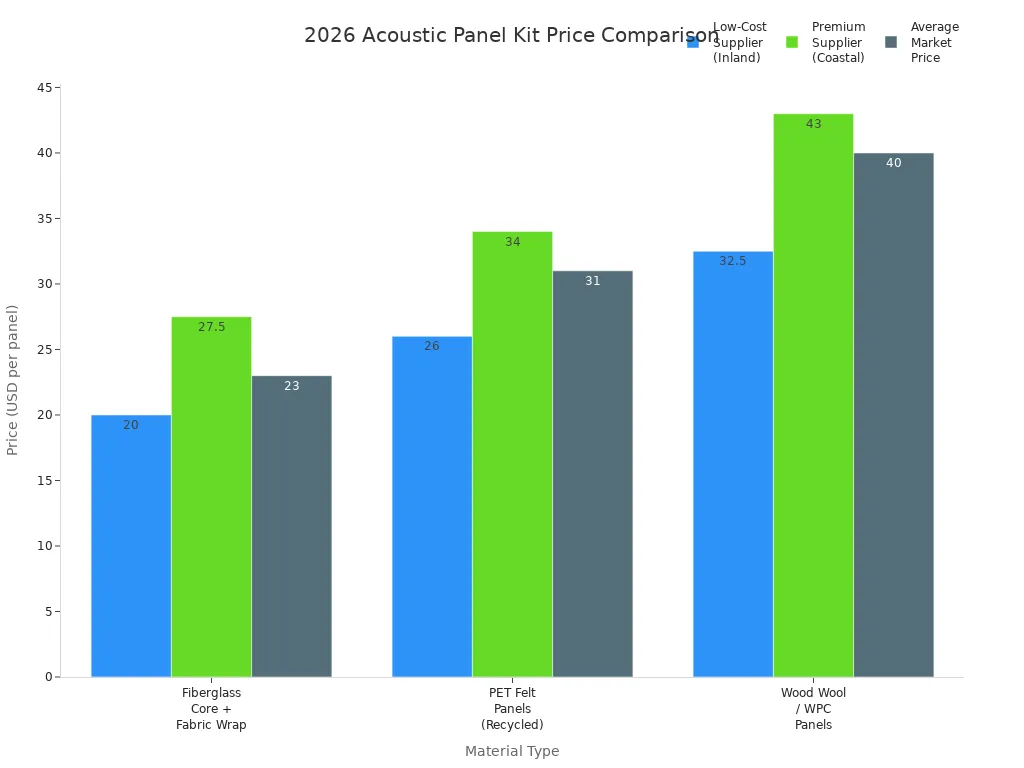
You might wonder about the price of acoustic panels. In 2026, prices can be very different. Economy kits cost from $508.48 to $664.94. Standard panels sell for $47 to $265 each. Panels are made from different materials. Each material changes the price. The table below shows average prices for popular materials from big suppliers:
Material Type | Low-Cost Supplier (Inland) | Premium Supplier (Coastal) | Average Market Price |
|---|---|---|---|
Fiberglass Core + Fabric Wrap | $18–$22 | $25–$30 | $23 |
PET Felt Panels (Recycled) | $24–$28 | $30–$38 | $31 |
Wood Wool / WPC Panels | $30–$35 | $38–$48 | $40 |
The market for acoustical wall panels is getting bigger. In 2025, it was worth $10.74 billion. By 2026, it should reach $11.53 billion. This means prices are going up. You need a cost guide to help you plan before you buy.
There are many things that change the price of acoustic panels. The size of the panel matters. Bigger panels cost more because they use more material. The material type is important, too. Fabric-wrapped panels cost more. They look nice and block sound well. PET felt panels and wood wool panels have different prices.
Customization makes the price go up. If you want special colors, shapes, or logos, you pay more. Custom panels can make the total cost higher. You should check if the supplier has these options and ask for a cost guide.
Market changes also affect prices. Tariffs and trade rules can make imported materials cost more. The US and Europe have higher prices because of tariffs. More panels are made in the US now. This brings new designs and sometimes lower prices. Supply chain changes can make prices rise or fall. You need to keep up with these changes.
Tip: Always ask for a full cost estimate before you buy. This helps you avoid extra costs and plan your money.
Where you live can change the price, too. Some places pay more because of tariffs. Other places have cheaper prices because they make panels nearby. You should check prices in your area to save money.
The market will keep growing in the future. More people want acoustical panels for homes, offices, and factories. Cities are getting bigger and people care more about noise. Prices will keep changing as the market grows.
The market will grow by 1.8% each year from 2026 to 2034.
More people will want noise reduction in many places.
Cities and health concerns will make more people buy panels.
When you ask about the price of acoustic panels, you need to think about size, material, custom options, and market changes. These things decide the cost. Use this guide to compare prices and pick the best panels for you.
You need to know how many acoustic panels to buy before you start shopping. You can use a few simple rules to estimate the right amount. Here is an easy way to estimate:
Measure each wall. Multiply the height by the width to get the surface area.
Add the surface areas of all walls together.
Multiply the total wall area by 0.40. This gives you the target coverage in square feet.
Divide the target coverage by the size of one panel. This tells you how many panels you need.
You can also estimate by using the room volume. Measure the length, width, and height of your room. Multiply these numbers to get the volume. Use 4% of the volume for offices and 5% for studios or auditoriums. This helps you estimate the total panel area.
Tip: Always estimate a little extra if your room has hard surfaces like glass or concrete. These surfaces reflect more sound.
Let’s look at some common spaces and see how to estimate the number of panels you need. The table below shows examples for a home theater, office, and home studio. You can use the same steps to estimate for your own room.
Room Type | Dimensions (ft) | Wall Surface Area (sq ft) | 40% Coverage Target (sq ft) | Panel Size | Sq Ft Per Panel | Panels Needed |
|---|---|---|---|---|---|---|
Home Theater | 15 × 20 × 9 | 630 | 252 | 2' × 2' | 4 | 63 |
Office | 12 × 15 × 8 | 432 | 173 | 2' × 2' | 4 | 44 |
Home Studio | 10 × 12 × 8 | 352 | 141 | 2' × 2' | 4 | 35 |
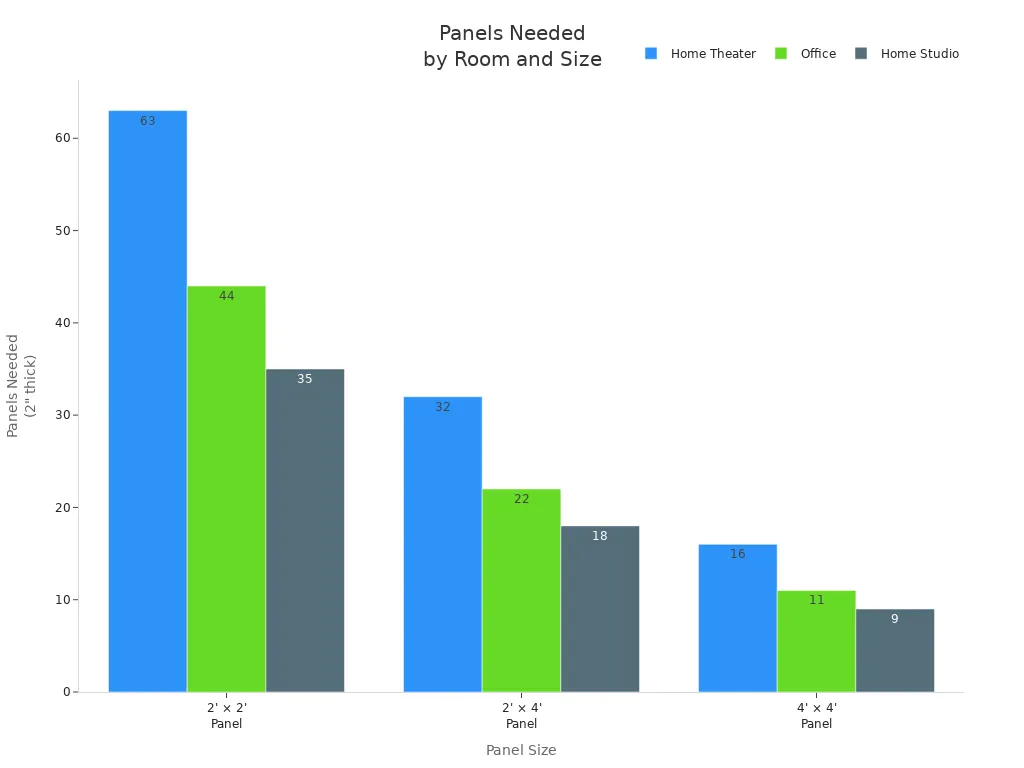
Different rooms need different amounts of panels. Studios need more panels for better sound control. Offices need enough panels to reduce echo and make speech clear. Large rooms like auditoriums need many panels. Always estimate based on your room’s size and use.
You can use these rules and examples to estimate your needs. This helps you plan your budget and avoid buying too many or too few panels. If you want the best results, estimate carefully and adjust for your room’s special needs.
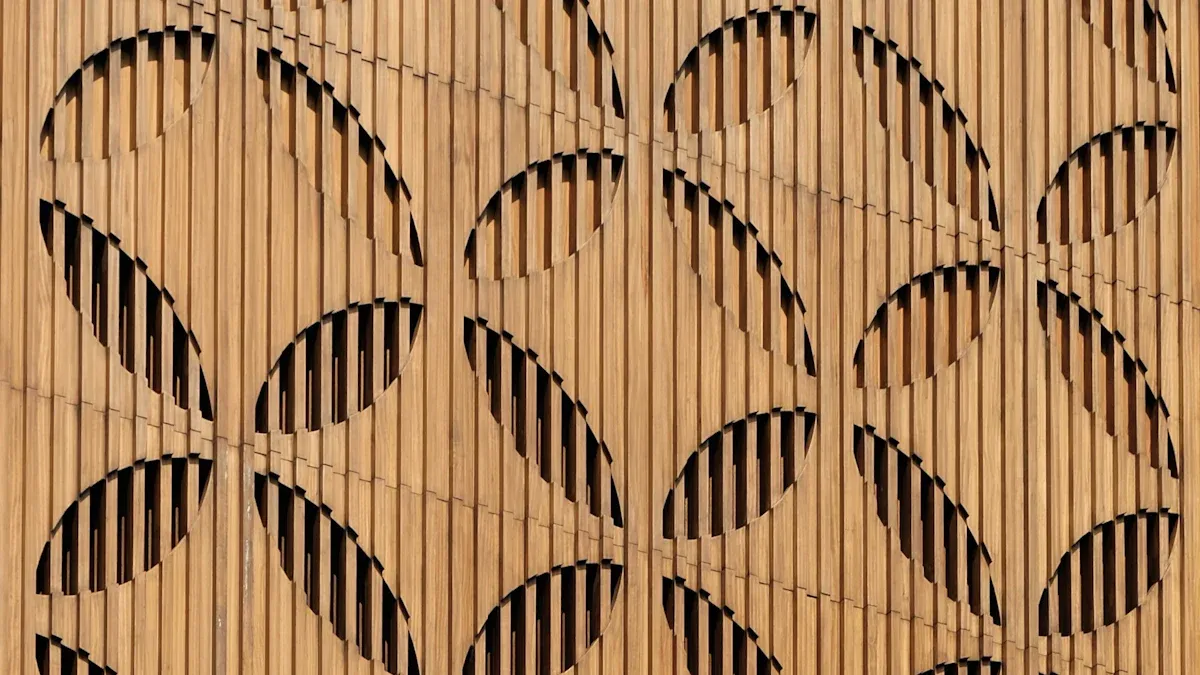
You can pick decorative or performance acoustic panels. Decorative panels cost more because they have custom colors and designs. Performance panels, like acoustical foam or CelluZorbe, focus on absorbing sound and usually cost less. PolyZorbe is a decorative panel that is affordable and absorbs sound well.
Decorative panels cost the most because they look special.
Performance panels are cheaper but not as nice to look at.
PolyZorbe gives you good sound control for a fair price.
The main material changes the price. Mineral wool or fiberglass makes panels cost more but work better. The outside fabric must let sound through. Designer fabrics can make panels cost more. Custom shapes and sizes also add to the price.
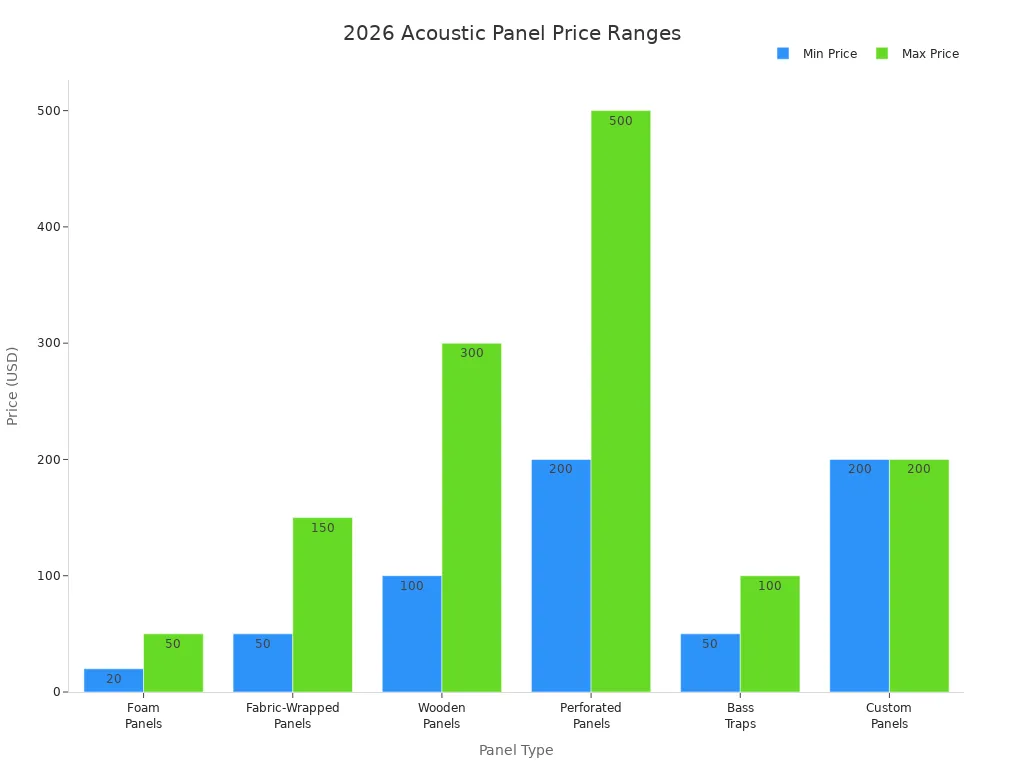
Budget panels are made from foam or simple wood fiber. These panels cost less but may not last long. Premium panels use strong wood or good fabric. They work better and last longer. The table below shows price ranges:
Type of Panel | Price Range |
|---|---|
Foam Panels | $20-$50 per pack |
Fabric-Wrapped Panels | $50-$150 per panel |
Wooden Panels | $100-$300 per panel |
Perforated Panels | $200-$500 per panel |
Bass Traps | $50-$100 per unit |
Custom Panels | $200+ per panel |
Acoustic wood panels can last 15–25 years. Acoustic foam may break down in 5–10 years, especially in damp rooms.
Busy places need strong panels. Wood slat panels are easy to clean and last longer. Fabric-wrapped panels should use good fabric for better sound control.
Acoustical wall panels cost different amounts based on what they are made of, their size, and how well they work. Basic panels cost $20 to $100 each. Middle-priced panels cost $100 to $300 each. Premium panels can cost $300 or more. Kits for big rooms can cost over $1,000. Simple fabric-wrapped panels are cheaper than custom wood slat panels.
Basic wood fiber panels can cost less than ten dollars.
Kits for big rooms can cost more than a thousand dollars.
Prices depend on materials, thickness, and how well they control sound.
You should make a smart budget for your project. Look for materials and brands that give you the best sound control for your needs. Acoustical wall panels have many prices, so you can find something for any space.
When you look at acoustic panels and soundproof foam, you see big price differences. Acoustic panels cost more at first. You usually need a pro to put them up. Soundproof foam is cheaper and you can put it up yourself. The table below shows how much each one costs:
Type | Installation Cost | Maintenance Cost | Price Range (per square meter) |
|---|---|---|---|
Acoustic Wood Panels | Higher upfront cost, needs a pro | Easy to clean, lasts a long time | $40–$150 |
Acoustic Foam | Low initial cost, DIY-friendly | Needs replacement more often, harder to clean | $10–$40 |
Tip: Foam is cheaper if you want to save money now. Panels last longer, so they are better if you want something that stays good.
You should think about how often you will need to get new foam or panels. Foam might need to be replaced more, so you could pay more later.
You want your room to sound better, so you need to know how each one works. Acoustic panels soak up sound from many types of noises. They use thick materials like fiberglass or rock wool. This makes them great for studios and offices. Soundproof foam works best for high sounds. It helps stop echo but does not work well for low sounds.
Here is a table to help you see the main differences:
Feature | Acoustic Panels | Soundproof Foam |
|---|---|---|
Main Function | Absorbs sound across many frequencies | Reduces echo, improves sound quality |
Material Density | High-density (fiberglass, rock wool) | Lightweight, porous (polyurethane, melamine) |
Frequency Response | Good for mid and low sounds | Best for high sounds |
Installation | Needs mounting, more complex | Easy, peel-and-stick |
NRC Rating | Higher, absorbs more sound | Lower, absorbs less sound |
Best Use | Studios, offices, commercial spaces | Home theaters, vocal booths, DIY |
Acoustic panels give you better sound control and last longer. Foam is easier to put up and costs less at first. But you might spend more later if you have to buy new foam. Pick what works best for your needs and your budget.
You can find economy kits that cost between $508.48 and $664.94. Standard panels cost from $47 to $265 each. When picking acoustic panels, think about these things:
The type and material of the panel change the price and how well it works.
NRC rating, thickness, and density are important for big rooms.
Custom sizes and finishes make panels cost more.
How you install and arrange panels affects how well they work.
Buying in bulk can make each panel cheaper.
You get the best results when you match your budget, room size, and what you need the panels to do. Look at custom options to make your space fit your needs.
You need to add up all the costs. First, add the price of each panel. Then, include installation fees and shipping. Custom options can also cost more. Always ask for a full quote before you buy. This helps you know the real price. You will not get surprised by extra costs.
Many panels are easy to put up with simple tools. Some panels are heavy or big. These might need a professional to help. Always read and follow the instructions from the company.
Most panels last from 10 to 25 years. Foam panels can break down faster in wet rooms. Wood and fabric panels last longer if you clean them often.
Tip: Use a soft brush or vacuum to clean panels. This keeps them working well.
Yes, custom colors, shapes, or logos cost more money. Standard panels are cheaper. If you want your panels to look special, ask for a custom price.
Feature | Standard Panel | Custom Panel |
|---|---|---|
Price | Lower | Higher |
Color Choices | Limited | Many |
Shapes | Basic | Any |

